
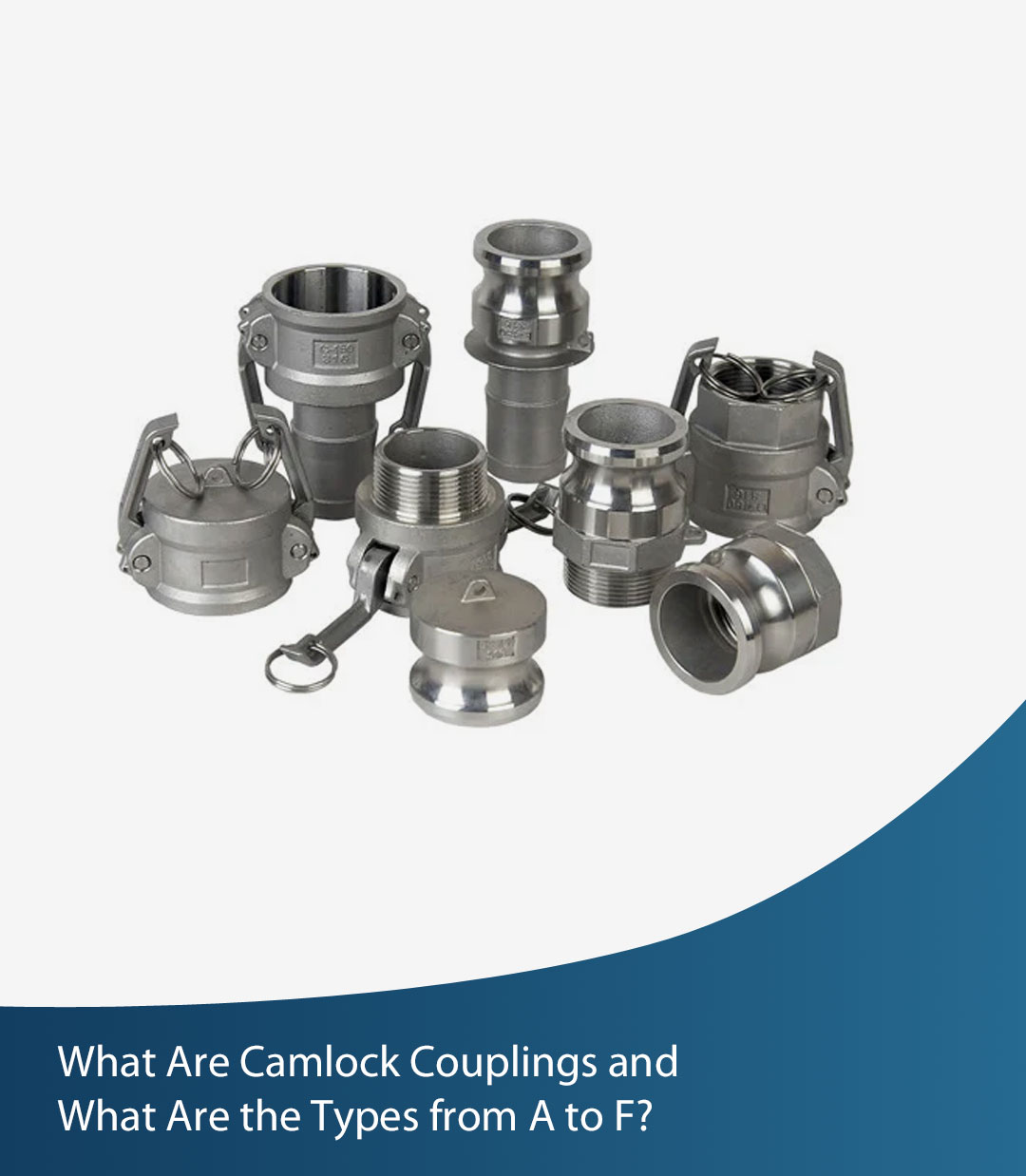
Camlock Couplings, also known as Cam and Groove Couplings, are standardized quick-connect fittings used for transferring fluids, powders, or gases. They are popular in industries like chemical, agriculture, food, petroleum, and construction, thanks to their tool-free, leak-proof, and reliable connection mechanism.
Camlock fittings are categorized into Types A to F based on their end connection and gender (male/female). Each type is used differently depending on the hose, pipe, or equipment configuration.
In this complete guide, you’ll learn:
- The full breakdown of Types A to F
- How each type works
- Applications, material options, sizing, and selection tips
How Does a Camlock Coupling Work?
Camlock couplings operate on a simple locking system:
- One end has cam arms (female coupler).
- The other end has a grooved adapter (male plug).
- When inserted together and the arms are folded down, the cam arms lock the plug in place, forming a tight, pressure-sealed connection.
There are no threads, tools, or torque needed.
This mechanism makes them:
- ✅ Fast to operate
- ✅ Spill-resistant
- ✅ Suitable for frequent connect/disconnect operations
Overview of Camlock Coupling Types (A–F)
| Type | Description | Male/Female | Use |
|---|---|---|---|
| Type A | Male adapter × Female NPT thread | Male | Connects to female threaded pipe |
| Type B | Female coupler × Male NPT thread | Female | Connects to male threaded pipe |
| Type C | Female coupler × Hose tail | Female | For hose-to-hose or equipment |
| Type D | Female coupler × Female NPT thread | Female | Connects to male threaded pipe |
| Type E | Male adapter × Hose tail | Male | Hose connection with female coupler |
| Type F | Male adapter × Male NPT thread | Male | Connects to female threaded pipe |
Let’s explore each one in detail.
Type A Camlock Coupling – Male Adapter × Female Thread
🔧 Configuration:
- Male Camlock adapter (plug)
- Female NPT/BSP thread
🔍 Applications:
- Screwed into female-threaded equipment or pipe
- Common in transfer lines, pumps, tanks
✅ Pros:
- Simple installation into stationary threaded lines
- Can connect to any Type B, C, or D female coupler
🧪 Material Options:
- Aluminum, Brass, Stainless Steel, Polypropylene, PTFE-lined
Type B Camlock Coupling – Female Coupler × Male Thread
🔧 Configuration:
- Female Camlock coupler with cam arms
- Male NPT/BSP thread on the other end
🔍 Applications:
- Threaded into a male-threaded pump or pipe
- Allows female cam arm side to receive a Type A, E, or F adapter
✅ Pros:
- Easy to disconnect and maintain
- Common in chemical unloading systems and tanks
Type C Camlock Coupling – Female Coupler × Hose Tail
🔧 Configuration:
- Female cam arm side
- Barbed hose tail end
🔍 Applications:
- Connects flexible hose to Type E or F
- Used in irrigation, construction water lines, or tankers
✅ Pros:
- Very fast hose-end connection
- Ideal for suction and delivery hoses
🧪 Popular Materials:
- Aluminum for water, SS for chemicals, Poly for agriculture
Type D Camlock Coupling – Female Coupler × Female Thread
🔧 Configuration:
- Female Camlock with cam arms
- Female NPT/BSP thread on the other end
🔍 Applications:
- Receives Type A, E, or F plugs
- Threads into male-threaded tanks or valves
✅ Pros:
- Full female-female configuration
- Ideal for hose-to-valve or hose-to-equipment conversion
Type E Camlock Coupling – Male Adapter × Hose Tail
🔧 Configuration:
- Male Camlock plug
- Hose barb tail end
🔍 Applications:
- Pushes into Type B, C, or D female coupler
- Used for suction, irrigation, and discharge hoses
✅ Pros:
- Lightweight
- Good for low to medium-pressure fluid movement
Type F Camlock Coupling – Male Adapter × Male Thread
🔧 Configuration:
- Male Camlock plug
- Male NPT/BSP thread on the other side
🔍 Applications:
- Screwed into female-threaded pipes or tanks
- Connects to Type B, C, or D
✅ Pros:
- Ideal for fixed installations
- Can be left in place while hose coupler detaches easily
Material Selection Guide for Camlock Couplings
| Material | Best Used For |
|---|---|
| Aluminum | Water, fuel, low-cost fluid systems |
| Stainless Steel (SS 304 / 316) | Corrosive chemicals, food, pharma |
| Brass | Fuel, oil, mild acids |
| Polypropylene | Agricultural chemicals, water |
| PTFE-Lined | High-purity or corrosive acid transfer |
Note: Always match gasket material (NBR, Viton, EPDM) to the media being handled.
Size & Pressure Ratings
| Size | Common Pressure Rating |
|---|---|
| 1/2” to 2” | 150–250 PSI |
| 3” to 4” | 75–150 PSI |
| 6” and above | 50–100 PSI (depends on material) |
Larger sizes reduce pressure rating. Polypropylene couplings also handle less PSI than metal ones.
Typical Applications by Type
| Industry | Common Camlock Types Used |
|---|---|
| Chemical Transfer | B, D, F (SS) |
| Fuel Dispensing | A, F, E (Aluminum, Brass) |
| Agriculture Spraying | C, E, B (Poly, Brass) |
| Food and Pharma | A, B, D (SS316, PTFE seals) |
| Tank Truck Connections | C, E, F (Aluminum, SS) |
| Water Supply/Drainage | A to E (Aluminum, Poly) |
Installation & Safety Tips
- Always match male-female types correctly
- Do not use Type A or F with flexible hose directly (they’re threaded)
- Use locking clips or safety pins to prevent cam arm disengagement
- Regularly inspect cam arms and gasket condition
- Don’t exceed pressure ratings—especially in plastic variants
FAQs
Q1. What are the different types of Camlock fittings?
Types A, B, C, D, E, and F. Each has a different thread or hose connection.
Q2. What is a Type C Camlock?
It has a female cam arm side and a hose barb on the other end, ideal for connecting hoses to male adapters.
Q3. Can you mix Camlock sizes or types?
You must match the same size across types, but types A–F can be combined correctly (e.g., A to B, C to E, etc.)
Q4. Which Camlock is best for chemical use?
Stainless steel Camlocks with Viton seals are best for chemicals.
Q5. Are Camlocks reusable?
Yes. Camlocks are designed for frequent reuse with minimal maintenance.
How to Choose the Right Camlock Type?
Your selection depends on:
- ✅ Media compatibility (fuel, acid, water, etc.)
- ✅ Installation type (threaded, hose, tank-mounted)
- ✅ Coupling frequency (daily, weekly, seasonal)
- ✅ Pressure and temperature
- ✅ Industry regulations (FDA, ATEX, etc.)
Always consult with a trusted industrial coupling supplier to avoid mismatches and media failure.
Need Camlock Couplings in Type A to F?
We stock and export:
- ✅ Aluminum, Brass, SS, Polypropylene Camlocks
- ✅ Sizes from ½” to 6”+
- ✅ Type A to F, Dust Caps, Dust Plugs
✅ Custom threads (BSP, NPT) & gasket types