
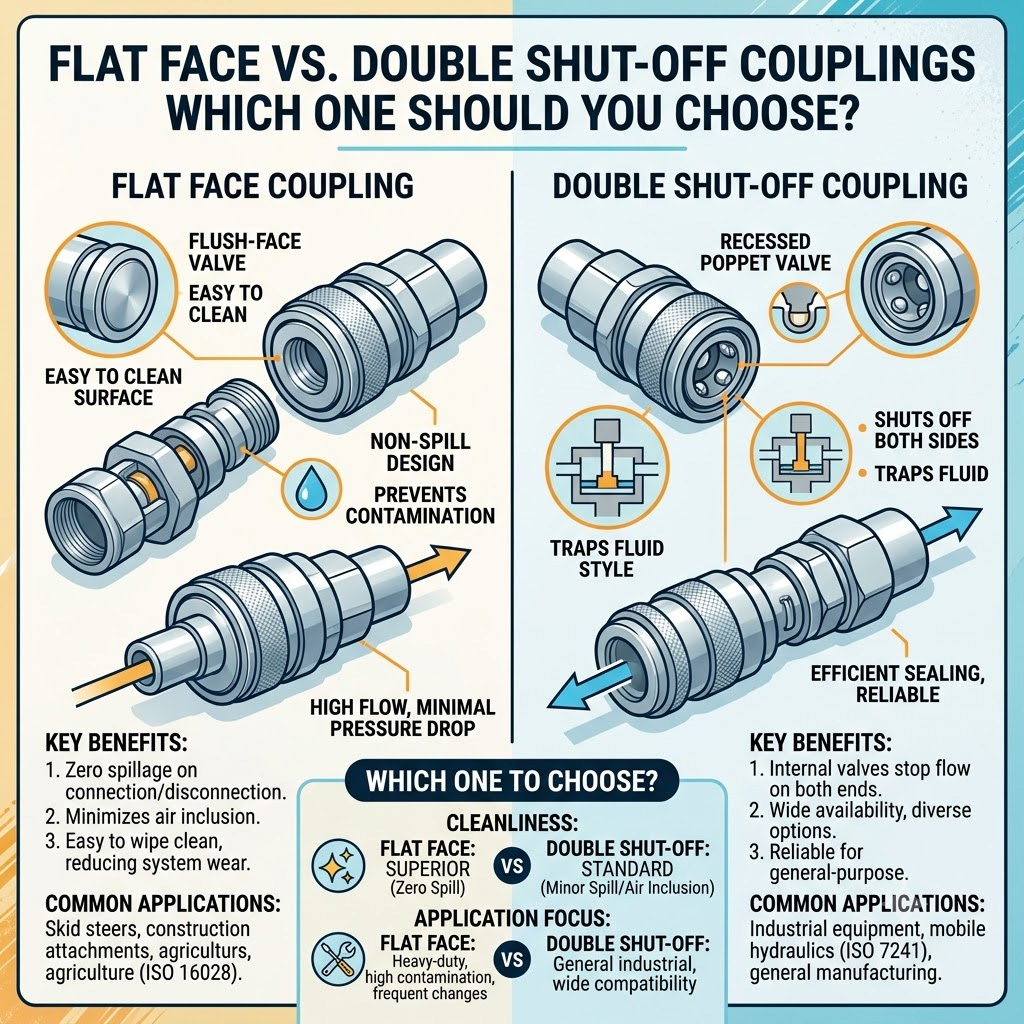
When working with fluid transfer systems, the right Quick Release Coupling (QRC) can make all the difference in performance, safety, leakage prevention, and maintenance costs.
Two of the most common types are:
- Flat Face Couplings
- Double Shut-Off Couplings
Though both are engineered for leak-free disconnection and high-pressure systems, they serve different purposes and offer distinct advantages.
In this guide, we’ll compare flat face vs. double shut-off couplings in depth—covering design, operation, use cases, pros and cons, and which one is better for your system.
What Are Flat Face Couplings?
Flat Face QRCs are specially designed to:
- Prevent fluid loss and contamination
- Eliminate air inclusion during reconnection
- Maintain a smooth, flush mating surface
They are widely used in:
- Mobile hydraulics
- Heavy equipment
- Agricultural machinery
- Cleanroom fluid systems
🔍 Key Features:
- Zero-spill disconnection
- Flush sealing faces (no cavities or crevices)
- Easy to clean and maintain
- Designed as per ISO 16028 standard
- Available in SS 316, carbon steel, brass
What Are Double Shut-Off Couplings?
Double Shut-Off Couplings contain shut-off valves on both the plug and socket, ensuring zero fluid or pressure loss when disconnected.
These are more traditional in design and are widely used in:
- Industrial hydraulic systems
- Chemical lines
- Compressed air and gas systems
🔍 Key Features:
- Spring-loaded poppet or ball valves on both sides
- Prevents backflow or contamination
- Rated for medium to high pressure
- Designed per ISO 7241-A / 7241-B and DIN standards
Flat Face vs. Double Shut-Off – Key Differences Table
| Feature | Flat Face Couplings | Double Shut-Off Couplings |
|---|---|---|
| Valve Type | Non-poppet flat seal | Dual poppet valves |
| Leak Prevention | Best-in-class (no spill) | Moderate to good |
| Contamination Control | Excellent | Good |
| Media Compatibility | Hydraulic oil, fuel, food-grade | Oil, air, gas, water |
| Ease of Cleaning | Very easy (flat surfaces) | More effort (valve cavities) |
| Air Inclusion on Reconnect | Minimal | Higher risk |
| Standard Compliance | ISO 16028 | ISO 7241-A/B, DIN |
| Cost | Higher | Moderate |
| Disconnection Force | Low to medium | Medium to high |
| Applications | Mobile hydraulics, defense, food, pharma | General industrial use, tools, water lines |
How Flat Face Couplings Work
- When connected: Media flows freely through smooth flat-face valves.
- When disconnected: Internal valves close flush against a flat surface.
- There is no cavity, so no trapped fluid to leak or contaminate.
This design ensures:
- ✅ No oil spill
- ✅ Minimal pressure drop
- ✅ Faster clean-up time
- ✅ Environmental compliance
How Double Shut-Off Couplings Work
- Plug and socket each contain a spring-loaded valve (usually poppet or ball).
- When connected, both valves open to allow flow.
- Upon disconnection, both ends seal off individually, preventing backflow.
This is ideal for systems where:
- The media must be sealed in both ends
- There is a risk of pressure surge
- The connection needs to be secure under varying angles
Application Comparison by Industry
| Industry | Flat Face QRC | Double Shut-Off QRC |
|---|---|---|
| Construction (Excavators) | ✅ | ✅ |
| Pharma / Food | ✅ | ❌ (due to cavity) |
| Hydraulic Mobile Machines | ✅ | ✅ |
| Compressed Air Lines | ❌ | ✅ |
| Chemical Plants | ✅ (corrosive media) | ✅ |
| Power Generation | ✅ | ✅ |
| Aerospace | ✅ (clean disconnect) | ✅ |
| Oil & Gas | ✅ | ✅ |
| General Factory Use | ❌ (costly) | ✅ |
Cost & Maintenance Comparison
| Parameter | Flat Face QRC | Double Shut-Off QRC |
|---|---|---|
| Initial Cost | Higher | Moderate |
| Maintenance | Easy – flush clean | Requires disassembly |
| Leak Test Frequency | Less frequent | Regular intervals |
| Spare Parts | Valve seals, O-rings | Valve springs, poppets |
| Life Expectancy | 3–5 years (heavy duty) | 1.5–3 years |
While flat face couplers are more expensive upfront, they reduce:
- Fluid loss
- Cleaning labor
- Risk of cross-contamination
This often justifies their use in mission-critical systems.
Buyer’s Checklist – Which One to Choose?
| Requirement | Recommended Coupling |
|---|---|
| Zero fluid loss | Flat Face |
| Standard hydraulic use | Double Shut-Off |
| Environmentally sensitive area | Flat Face |
| Cost-effective solution | Double Shut-Off |
| Corrosive fluid (chemicals) | Flat Face (SS or PTFE seals) |
| Frequent disconnection | Flat Face |
| Compressed air line | Double Shut-Off |
| High cycle operation | Flat Face |
| Food or pharma fluid handling | Flat Face only |
Case Study – Excavator vs. Food Plant
Case 1 – Excavator Manufacturer (Hydraulic):
Used double shut-off QRCs initially. Faced oil drips during tool changeovers. Shifted to flat face QRCs, reducing downtime and cleanup time by 30%.
Case 2 – Food Processing Unit:
Switched from double shut-off to flat face stainless couplings. Reduced contamination risk and improved clean-in-place performance.
FAQs
Q1. What is a flat face coupling?
A quick coupling with flush surfaces that prevents leaks and air inclusion during disconnection.
Q2. Are flat face QRCs better than double shut-off?
Yes, for critical, clean, or hazardous systems. They’re more leak-proof and cleaner but costlier.
Q3. Can I use double shut-off QRCs in chemical lines?
Yes, if the internal valve materials are compatible. But flat face is often better for cleanliness.
Q4. Are flat face couplings reusable?
Yes, and they’re highly durable. Many come with Viton or FKM seals for aggressive environments.
Q5. What’s ISO 16028?
An international standard for flat face hydraulic couplings used in mobile machinery.
Pros and Cons
✅ Flat Face Coupling – Pros:
- 100% leak-proof
- Clean disconnect
- Safer for environment
- Easy to wipe down
- Prevents air pockets
❌ Flat Face – Cons:
- Higher cost
- Slightly lower flow rate
- Not ideal for low-cost tools
✅ Double Shut-Off Coupling – Pros:
- Affordable
- Reliable for oil/gas/water lines
- Widely available in all sizes
- Good sealing when maintained
❌ Double Shut-Off – Cons:
- Can trap dirt or media
- Risk of small leaks
- Slower to clean
- Air inclusion during connection
Final Verdict – Which Is Better?
There’s no universal winner—the best choice depends on your:
- Application (Hydraulics? Air tools?)
- Media (Oil? Gas? Chemicals?)
- Industry (Food? Construction?)
- Budget vs Maintenance Trade-Off
🔹 Use Flat Face Couplings for:
- Clean, leak-free performance
- Harsh, dirty, or sensitive environments
- Long lifecycle with minimal fluid waste
🔸 Use Double Shut-Off Couplings for:
- General industrial pipelines
- Compressed air, water, or basic oils
- Cost-sensitive systems with standard maintenance