
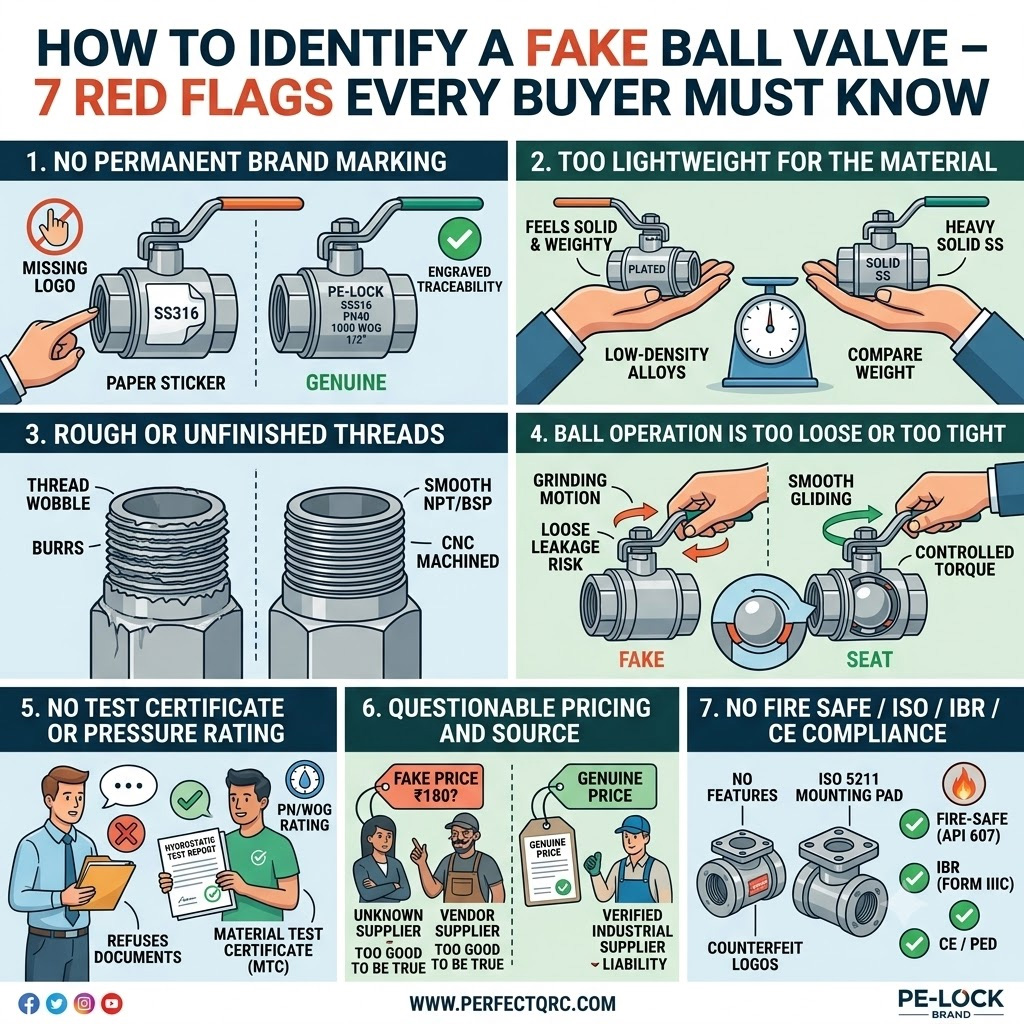
In today’s global industrial market, counterfeit ball valves have become a silent threat—especially in high-risk industries like oil & gas, chemicals, pharmaceuticals, and water treatment. While they may look similar on the outside, fake valves can lead to:
- Catastrophic leakage
- Process shutdowns
- Safety hazards
- Major financial loss
This blog outlines 7 major red flags that will help buyers, engineers, and procurement teams spot fake ball valves before it’s too late—especially when dealing with unknown suppliers or importers.
Why Are Fake Ball Valves So Dangerous?
Counterfeit ball valves may:
- Use inferior materials like low-grade brass or mixed scrap
- Carry fake brand markings or ISI/CE logos
- Fail under pressure or heat due to non-standard machining
- Come with incorrect threading, weak seals, and untested seats
Even one faulty valve in a pressurized system can cause:
- System-wide leakage
- Downtime losses
- Environmental hazards
- Legal liabilities
Red Flag #1 – No Permanent Brand Marking
A genuine industrial-grade ball valve always has:
- Laser-etched or casted marking of manufacturer name or logo
- Clear pressure rating (PN40, 1000 WOG, etc.)
- Size and material code (e.g., SS316, CF8M)
❌ Fake Valve Warning Signs:
- Paper stickers instead of engraved markings
- Misspelled brand names
- Missing traceability codes
- No QR or batch ID
🔍 Tip: Cross-check the marking with the manufacturer’s website or datasheet.
Red Flag #2 – Too Lightweight for the Material
A high-pressure SS ball valve (e.g., PN40, full bore) should feel solid and weighty.
❌ Common Fakes:
- Made from low-density alloys or zinc alloys plated to look like stainless
- Drilled out internally to save metal weight
- Use plastic balls inside instead of solid SS
📏 Quick Test:
Compare the weight of a genuine vs suspicious valve of same size — large differences mean red flag.
Red Flag #3 – Rough or Unfinished Threads
Thread quality is the backbone of leak-proof installation.
🧰 Genuine Valves:
- Use CNC-machined BSP/NPT threads
- Smooth, burr-free threading
- Precise dimensions as per ASME / ISO / DIN
❌ Fake Valve Issues:
- Thread wobble or loose fit
- Sharp burrs or uneven threading
- Coarse grooves and metal flaking
🛠️ Poor threads often lead to galling, leaks, or misfits with mating pipes.
Red Flag #4 – Ball Operation Is Too Loose or Too Tight
A real valve ensures controlled torque movement using:
- PTFE or TFM seats
- Lubricated stems
- Anti-static balls
❌ Counterfeit Indicators:
- Too tight: Ball grinding due to bad machining
- Too loose: Excessive seat clearance, leads to leakage
- Handle feels “gritty” or doesn’t lock in position
💡 Tip: Rotate the handle fully—smooth, gliding motion is a good sign.
Red Flag #5 – No Test Certificate or Pressure Rating
A genuine industrial valve comes with:
- Hydrostatic test certificate
- Mill Test Certificate (MTC)
- Verified PN/WOG rating
❌ Fake Valve Signs:
- Vendor refuses to give any test report
- Fake test certificate with no serial or signature
- Uses vague terms like “Tested OK” or “Export Grade” with no data
🚫 No testing = No accountability. Never install such a valve in a critical system.
Red Flag #6 – Questionable Pricing and Source
❌ Common Clues:
- Price is too low to match the claimed material (e.g., “SS316 full bore for ₹180?”)
- Supplier is unknown, has no website, or operates only via WhatsApp
- “OEM” or “unbranded” claim with no liability
- No return, exchange, or warranty policy
💡 Golden Rule: If the price is too good to be true, it probably is.
Red Flag #7 – No Fire Safe / ISO / IBR / CE Compliance
Most industrial ball valves require:
- Fire-safe design (API 607)
- ISO 5211 mounting pad
- IBR certification (India)
- CE or PED compliance (Europe)
❌ Red Flag:
Fake products carry counterfeit logos or missing certifications. Always ask for:
- CE Certificate copy
- IBR Form IIIC
- ISO 9001 docs from OEM
📩 If the supplier dodges or delays this, walk away.
Summary Table – Red Flags Checklist
| Red Flag | What to Check |
|---|---|
| Brand Marking | Laser-etched logo, pressure, size |
| Weight | Feels heavy and solid |
| Threads | CNC-finished, smooth BSP/NPT |
| Handle | Smooth, firm rotation |
| Test Report | Hydrostatic + MTC with serial no. |
| Pricing | In line with genuine market rate |
| Certifications | Fire-safe, CE, ISO, IBR proof |
✅ A real valve will pass all 7 tests. A fake will fail at least 2–3.
Industries Most at Risk of Counterfeit Valves
| Industry | Risk Level | Why |
|---|---|---|
| Oil & Gas | 🔴 Very High | High volume, cost-cutting pressure |
| Chemical | 🔴 High | Hazardous media & temp |
| Pharma | 🟠 Medium | Strict hygiene + metal specs |
| HVAC | 🟡 Medium | Use of local vendors |
| Water Treatment | 🟠 Medium | Bulk purchase, low cost focus |
| Food Industry | 🔴 High | Needs sanitary design, fake SS risk |
How to Verify a Ball Valve Is Genuine?
✅ Request:
- MTC (Material Test Certificate)
- Pressure test report (PN rating)
- Manufacturer-signed warranty
- Supplier’s GST/Import ID
- ISO/CE/IBR certifications
🧾 Bonus Tip: Google the supplier name + “fake valve” or “review” to find complaints.
FAQs
Q1. How can I check if my ball valve is original?
Check for laser marking, test report, smooth operation, proper weight, and valid certifications.
Q2. Are fake ball valves common in India?
Yes, especially in unregulated markets and B2B resellers offering “OEM surplus” or deep discounts.
Q3. Can fake SS valves rust?
Yes. Fake “SS316” is often made from low-grade stainless that corrodes within weeks.
Q4. Can I trust imported valves from China or Dubai?
Only if sourced from known manufacturers with valid docs. Many counterfeits are circulated as OEM from these routes.
Q5. Why are fake valves dangerous?
They may burst, leak, or fail under temperature or pressure—posing safety, cost, and legal risks.
Final Advice – Don’t Let Price Fool You
When buying a ball valve:
- Prioritize quality, certification, and traceability
- Work with a verified industrial supplier or manufacturer
- Always inspect and test before installation
🎯 Cheap valves are expensive mistakes.
Need Certified Ball Valves with Test Reports?
We supply:
- ✅ IBR / CE / ISO-approved ball valves
- ✅ 1000 WOG, PN40, Fire-Safe, Anti-Static
- ✅ Material traceability (SS316 / CF8M / Brass)
- ✅ Sizes from ¼” to 6” | BSP / NPT / Socket Weld
- ✅ 100% tested with reports
📩 Request a Quote | 📥 Download Our Ball Valve Brochure | 📞 Talk to Our Technical Team Now