
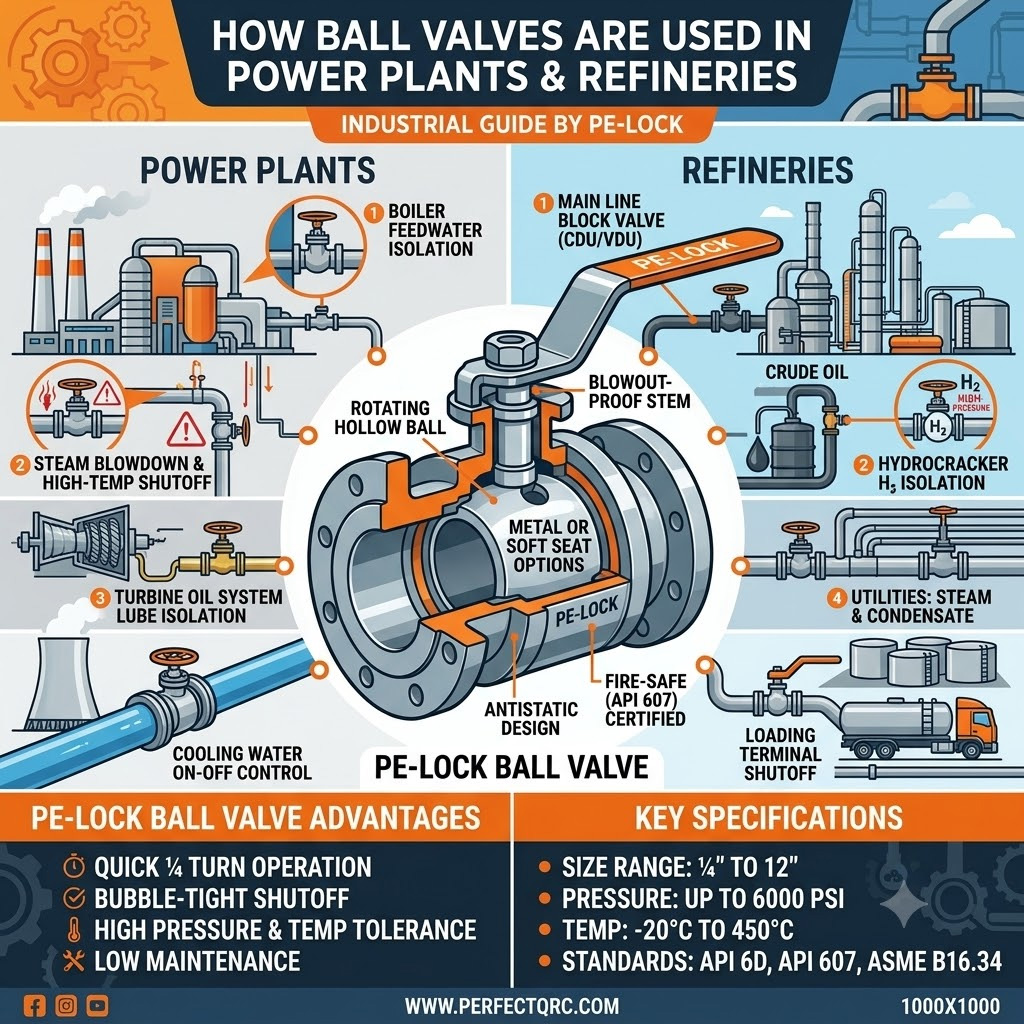
In power generation and refining industries, where extreme pressures, temperatures, and volatile media are the norm, every valve matters. A single leak, delay, or failure in shutoff can cost millions in downtime, accidents, or system collapse.
Among all types of industrial valves, ball valves have become a go-to choice for:
- Reliable flow shutoff
- High-pressure tolerance
- Quick open-close operation
- Long lifecycle with minimal maintenance
In this guide by Perfect Engineers – PE-LOCK, we break down exactly how and where ball valves are used across thermal power plants, refineries, and energy systems—helping EPC contractors, OEMs, and plant engineers make better purchase and design decisions.
What Is a Ball Valve?
A ball valve is a quarter-turn valve that uses a rotating hollow ball to control fluid flow.
- When the ball’s bore is aligned with the pipe, flow passes through.
- When rotated 90°, the bore is perpendicular—flow stops.
PE-LOCK manufactures metal-seated and soft-seated ball valves, designed for steam, gas, chemical, and hydrocarbon services common in power plants and refineries.
Applications of Ball Valves in Power Plants
In power plants (thermal, nuclear, hydro, gas turbine), ball valves are used in:
| Area | Application | Valve Size |
|---|---|---|
| Boiler Feedwater | Isolation lines, pump bypass | 1”–4” |
| Condensate Return | System drain & trap | ½”–2” |
| Steam Blowdown | High-temp shutoff | 1”–6” |
| Cooling Water Lines | On-off control | 2”–12” |
| Turbine Oil Systems | Lube oil isolation | 1”–3” |
| Fuel Gas | Quick shutoff | ½”–2” |
| Air Compressors | Safety lines, instrumentation | ¼”–1” |
✔️ PE-LOCK high-pressure ball valves can handle temperature ranges from –20°C to 450°C and pressures up to 6000 PSI, depending on design.
Ball Valve Applications in Refineries
Refineries handle hydrocarbons, steam, high-viscosity fluids, and corrosive gases.
| Refinery Unit | Valve Use | Media |
|---|---|---|
| CDU/VDU | Main line block valve | Crude oil |
| Hydrocracker | Isolation + emergency shutoff | H₂-rich gas |
| Reformers | On-off + safety isolation | Naphtha |
| Utilities | Steam, condensate, water | Thermal fluid |
| Sulfur Recovery | Acid gas handling | SO₂, H₂S |
| LPG Lines | Secure shutoff | Propane, butane |
| Loading Terminals | Tanker loading lines | Petrol, diesel |
📌 PE-LOCK ball valves are fire-safe certified, available in trunnion or floating design, and can be supplied with anti-static, blowout-proof stems for refinery safety.
Why Ball Valves Are Preferred in Energy Applications
| Feature | Why It Matters |
|---|---|
| Quick ¼ Turn Operation | Fast shutoff in emergencies |
| Bubble-Tight Shutoff | Zero leakage in gases/steam |
| High Pressure & Temp Ratings | Withstands severe plant conditions |
| Compact Design | Ideal for space-constrained units |
| Automation-Ready | Easily motorized or pneumatically actuated |
| Low Maintenance | Long life, no constant greasing |
PE-LOCK’s ball valves are designed for over 100,000 cycles, even in harsh refinery or turbine environments.
PE-LOCK Ball Valve Range for Power & Refinery Plants
| Valve Type | Size | Pressure Rating | Body Material |
|---|---|---|---|
| Floating Ball Valve | ½”–4” | Up to 2500 PSI | SS316, CS |
| Trunnion Mounted Ball | 2”–12” | 600–2500 Class | WCB, LCB, CF8M |
| Three-Piece Design | ¼”–3” | 1000–3000 PSI | SS316 |
| Full Bore | ½”–6” | As per API 6D | CS, SS |
| Fire-Safe Ball Valve | 1”–6” | API 607 | SS316, Monel |
✅ Seat Options: PTFE, RPTFE, Devlon, Metal
✅ End Options: Flanged, Screwed, Socket Weld, Butt Weld
✅ Optional Coating: PTFE, ENP, Zinc Nickel, IBR-certifiable
FAQs
Q1. Why are ball valves used in power plants?
They ensure fast shutoff, withstand high pressure/temperature, and need low maintenance.
Q2. Which valves are used in refineries?
Ball valves are used along with gate, globe, and plug valves—mainly for isolation and emergency shutdown.
Q3. Can ball valves handle steam?
Yes, PE-LOCK ball valves with metal seats or PTFE-graphite seals are steam-rated.
Q4. What material is best for refinery ball valves?
WCB (carbon steel) and SS316 are most used. Exotic alloys like Monel or Hastelloy are used for acid gas lines.
Q5. Can PE-LOCK supply fire-safe ball valves?
Yes, our ball valves comply with API 607 fire-safe standards and come with certification.
Comparison – Ball Valves vs Gate Valves in Plants
| Feature | Ball Valve | Gate Valve |
|---|---|---|
| Open-Close Time | ✅ Fast | ❌ Slow |
| Leak Tightness | ✅ Excellent | ⚠️ Moderate |
| Maintenance | ✅ Low | ⚠️ Medium |
| Size & Space | ✅ Compact | ❌ Bulky |
| Automation | ✅ Easy | ⚠️ Complex |
| Ideal For | On-off & emergency | Isolation over long periods |
👉 In refineries and power plants, ball valves are often used where speed and tight shutoff are essential.
Special Variants Supplied by PE-LOCK
- 🔥 Fire-Safe Ball Valves – API 607 certified
- ⚡ Electrically Actuated Ball Valves – Remote control for boiler/turbine lines
- 🛑 Emergency Shutdown Valves (ESD) – Spring return + solenoid
- 🧪 PTFE Coated Ball Valves – For acid service in scrubbers
- 🧲 Anti-static Ball Valves – Prevents ignition risk in gas plants
- 🧩 Low Torque Valves – For easy actuation in remote locations
Certifications & Standards Followed
All PE-LOCK ball valves for power and refinery sectors conform to:
- ✅ API 6D / API 607 (Fire Safe)
- ✅ ASME B16.34 / B16.10
- ✅ BS EN ISO 17292
- ✅ IBR Certification (for boiler lines)
- ✅ PED / CE on request
- ✅ MTC & NACE MR0103 compliance (for sour service)
Where PE-LOCK Ball Valves Are Used Globally
| Project | Country | Valve Type |
|---|---|---|
| NTPC Thermal Plant | India | SS ball valves for boiler systems |
| ADNOC Oilfield Skid | UAE | Fire-safe trunnion-mounted valves |
| Petrochemical Tank Farm | Singapore | PTFE coated ball valves |
| Fertilizer Complex | Bangladesh | 3-piece valves for ammonia lines |
| Mini Refinery Project | Nigeria | Full bore API 6D valves |
📌 Exported in bulk quantities with test reports, packaging & traceability.
Buyer Tips – Choosing the Right Ball Valve
- ✅ Check pressure & temperature ratings
- ✅ Confirm seat material compatibility (PTFE, graphite, metal)
- ✅ Select end connection based on piping layout
- ✅ Ask for fire-safe or anti-static features if handling flammable media
- ✅ For remote locations, choose low torque or actuated versions
- ✅ Verify certifications (API, IBR, CE)
Installation & Maintenance Notes
- 🧼 Clean all sealing surfaces before installation
- 🛠️ Use correct torque on bolted body parts
- 🧴 Periodically lubricate stem (where applicable)
- 🔁 Avoid water hammer and pressure shocks during operation
- 🔧 PE-LOCK offers valve spares & servicing tools on request
Why PE-LOCK Ball Valves Are Ideal for Power & Refinery Projects
- ✅ 20+ years manufacturing for critical applications
- ✅ Trusted by EPC contractors & OEMs globally
- ✅ 100% pressure and seat leak tested
- ✅ Engineering support for BOM/design coordination
- ✅ Custom branding, casting, and design possible
- ✅ Fast delivery + export documentation + test reports
Ready to Source Ball Valves for Power or Refinery Projects?
Choose PE-LOCK by Perfect Engineers – the trusted name in:
- 🔧 Power plant pipeline valves
- 🛢️ Refinery and oilfield flow control
⚡ Electrically or pneumatically actuated ball valves